
Patient data security is a foundational requirement for any modern practice. A single dental data breach can compromise patient records, disrupt clinical operations, and trigger regulatory penalties. While many patient communication vendors treat cybersecurity as a checklist item, safeguarding Protected Health Information (PHI) requires rigorous, third-party validation. That is why modern dental practices demand HIPAA-compliant software backed by an independent System and Organization Controls (SOC) examination. In this guide, we break down what a SOC 2® Type 2 report actually entails, how it differs from self-attested HIPAA compliance, and how to keep your Practice Management System (PMS) secure from third-party vulnerabilities.
The Reality of a Dental Data Breach
In healthcare IT, security events are never trivial. When regulatory standards meet inadequate security infrastructure, the dental practice remains legally and reputationally accountable.
Even an unauthorized network incident exposing basic contact records or appointment schedules triggers the HIPAA Breach Notification Rule. This mandates notifying affected patients in writing, signaling to your local community that internal safeguards failed. When evaluating communication alternatives, practices must recognize that recovering from compromised data costs significantly more than deploying an audited, secure infrastructure from day one.
Understanding Compliance Standards: HIPAA vs. a SOC 2 Report
Many dental software vendors market themselves as "HIPAA-compliant," but in cloud software, basic compliance is often self-attested. To verify that a technology provider actively maintains enterprise-grade safeguards, practices must look for an independent SOC 2 Type 2 report.
HIPAA Compliance: Establishes legal baselines for safeguarding Electronic Protected Health Information (ePHI). It requires access controls, audit logging, and encryption, but does not mandate continuous external auditing of a vendor’s internal cloud infrastructure.
SOC 2 Type 2 Report: Developed by the American Institute of CPAs (AICPA), this examination evaluates how a service organization's controls operate over time. Unlike a Type 1 examination that checks controls on a single day, an independent CPA firm monitors the software provider over a 6- to 12-month period to verify the operational effectiveness of controls relevant to security, availability, and confidentiality.
Partnering with a vendor that successfully completes regular SOC 2 examinations provides verified proof that data handling controls are strictly maintained year-round.
Protecting Your Practice Management System Architecture
A common point of vulnerability in any practice is how third-party tools interact with the Practice Management System (PMS). Automated intake forms, messaging tools, or phone integrations that rely on unverified screen-scraping tools or store unencrypted patient data in external web consoles introduce unnecessary breach exposure.
Native API Writes vs. Third-Party Storage Silos
A secure communication platform minimizes liability by reducing its external data footprint.
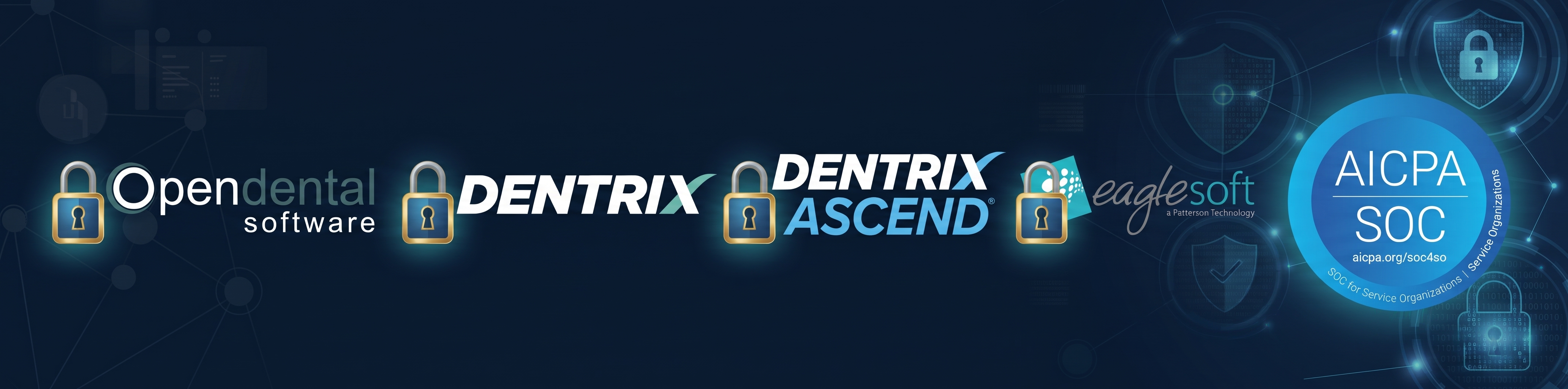
Whether your practice runs on Open Dental, Dentrix, Dentrix Ascend, or Eaglesoft, Powervox interacts directly with your database through official APIs and authorized middleware. Rather than siloing private records in an external dashboard, information flows securely into your practice’s native records:
Discrete Intake Writebacks: When patients submit digital intake links, clinical details map straight into patient charts—automatically populating native destination lists (such as Allergies, Medications, and Problems) without manual intermediary handling.
Zero Double-Entry: Administrative staff never need to transcribe private health details across disconnected screens, eliminating clerical errors and minimizing open-screen exposure.
Duplicate Chart Prevention: Built-in verification cross-references Date of Birth and phone numbers before writing appointments, maintaining chart integrity without generating fragmented duplicate files.
A Secure, Uncompromising Alternative
Your practice should never have to compromise its security standards to get modern front-desk automation.
Powervox provides a unified, HIPAA-compliant patient communication platform backed by an independent SOC 2 Type 2 report. Whether managing 24/7 AI Voice phone triage, two-way SMS scheduling, or digital treatment consent forms, all data interactions remain encrypted, audited, and tightly integrated into your native Open Dental, Dentrix, or Eaglesoft rules engine.
By consolidating single-point tools into a single, compliant platform, you remove the operational friction and security risks of juggling multiple unverified vendors.
Ready to protect your patient data and automate your front desk? Discover how Powervox delivers secure, PMS-integrated AI communications built for modern dental practices. Book a Demo today.